Tea cultivation in Sub‑Saharan Africa relies on a labor-intensive, perishable harvest that stretches worker vulnerabilities to trafficking.
Across key producers like Kenya, Uganda, Rwanda, Malawi, and Tanzania, smallholders and estate workers face seasonal surges in demand, piece-rate pay, and weak bargaining power—especially for small-scale farmers competing against commercial estates. Hazardous tasks such as weeding, plucking, and pesticide use are common, and child labor, migrant and casual workers, gender inequities, and limited oversight heighten risks of exploitation.
Overview of tea production in Sub-Saharan Africa
Trade
The top exporters of tea in sub-Saharan Africa are Kenya, Uganda, Malawi, Rwanda, Tanzania, South Africa, Zimbabwe, Burundi, Ethiopia, and Djibouti.[1] Kenya exported significantly more than any other country.
[2]
The top importers of tea from African countries are Egypt, the United Kingdom, Kenya, Russia, and Kazakhstan.[3]
Features of production and supply chain
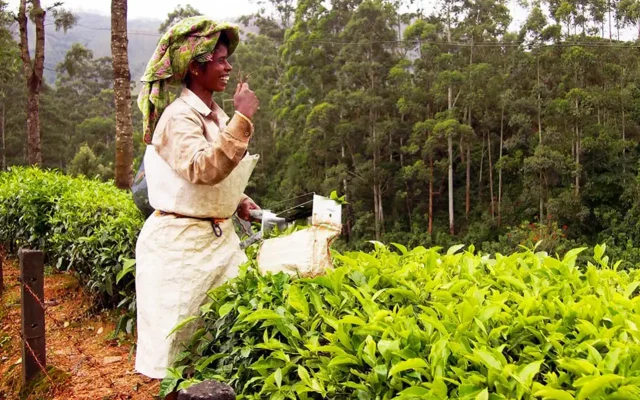
Many of the activities involved in tea production are labor intensive. Activities include preparing land, transplanting seedlings, applying mulch, applying fertilizer, manual weeding and leaf plucking.[4] Leaf harvesting generally represents a peak in manual labor.[5] Tea is harvested year-round, but high season depends on the exact region and type of tea.[6] After tea leaves are plucked, they need to be processed at the factory quickly because they are highly perishable. The factories may be located on commercial tea estates. At the factory, machines remove moisture, sort, and ferment the leaves. Tea is then sold by a range of mechanisms including, depending on the location, auctions, brokers or international traders to tea companies. The tea companies blend the tea and sell to retailers.[7]
There are two types of tea production in sub-Saharan Africa: small scale production and larger commercial plantations. There is no precise data about the scale of production on small farms versus estates, but small farms appear to be more prevalent in Africa than in tea producing regions in Sri Lanka and India. Over 60 percent of production takes place on small scale farms in Kenya.[8] Over 90 percent of production takes place on commercial estates in Malawi,[9] and over 70 percent on large estates in Uganda.[10]
Tea is highly perishable, and therefore the initial processing needs to take place quickly after harvest. Because processing takes place at commercial estates, small-scale farmers contract with these estate companies as buyers. In most locations, farmers do not have many options – or any options at all – in terms of which buyer to sell to, due to the isolated nature of processors. This lack of options can weaken the bargaining power of smallholder farmers.[11] Further, processing companies that have their own estates have lesser need to purchase from small holders, which can further weaken small producers’ positions.[12]
The type of production influences the type of labor utilized. Small-scale farmers typically rely heavily on family labor, but there appears to be significant use of hired/waged labor as well, particularly during peak harvest periods.[13] For example, among a sampled population in a small-holder tea-producing region in Uganda, over 50 percent of respondents had participated in waged labor on small tea farms in the past year.[14] Commercial estates utilize hired labor, but among these workers there is likely to be heterogeneity in status: some may be permanent, some may be temporary and some may be casual or hired by a third party labor provider.
Key documented trafficking in persons risk factors in tea production
Undesirable and hazardous work
Although low earnings are not inherently indicative of trafficking, they do indicate an overall level of vulnerability among tea producers and hired workers. For small-scale tea producers, the supply chain dynamics leading to a weak selling position with factories may contribute to decreased earnings. IDH reports that in Kenya, small-scale producers do not earn a living wage themselves, making it nearly impossible for them to pay living wages to hired workers. Low earnings, in combination with labor-intensive harvesting peaks may also incentivize reliance on unpaid family labor, including child labor.[15] Permanent workers tend to receive the highest wages and benefits (such as housing and access to medical care), although they are significantly less common than seasonal temporary workers. Hired workers in several countries, including Kenya, are paid a piece-rate.[16]
Vulnerable workforce
Child labor
The 2016 U.S. Department of State Trafficking in Persons Report notes “exploitation of children” on tea plantations in Cameroon.[17] According to the U.S. Department of Labor 2016 List of Goods Produced by Child Labor or Forced Labor, tea is produced using child labor in Kenya, Malawi, Rwanda, Tanzania, and Uganda.[18]
A study among child workers in the tea sector in Rwanda found that children were involved in the full range of tea production activities, including preparing land, pesticide application, and leaf harvesting. They also reported being involved in ancillary activities such as gathering firewood for factories. Among children in this study, child labor was found predominantly on smallholder farms.[19] Children make up an estimated 15 percent of all tea sector workers in Kenya.[20] A recent BBC investigation found hazardous child labor on a tea plantation in Uganda, where children carried seedlings up a steep hill and weeded rows.[21] According to the ILO, child labor on tea plantations in Tanzania is more prevalent among girls.[22] Until 2013, tea companies in Zimbabwe managed an “earn and learn” program in which children who worked on plantations could access schooling (with their tuition deducted from their wages), but the program was closed due to international pressure.[23]
[24]
Casual workforce
Seasonal workers reportedly typically receive higher wages than those engaged on smallholder farms because the piece-rates offered by plantations are higher.[25] Tea production takes a relatively large amount of land, so small-scale producers tend to lack left over land for planting subsistence crops; this can exacerbate poverty, making producers more vulnerable to food insecurity.[26]
Gendered dynamics of production
A study of gender roles in smallholder tea production in Kenya found that women are more likely to be engaged in more labor-intensive tasks in tea production – including leaf plucking and transporting plucked leaves – but were excluded from capacity building events such as producer trainings.[27] Similarly, a study in Rwanda found that women (who make up over half of workers on plantations) pluck and weed tea crops while men are more likely to supervise, drive trucks, or load/unload bags.[28] Sexual harassment has been noted on some plantations.[29]
Migrant labor
There is little data on the overall prevalence of migrant workers in African tea production but there are anecdotal reports that in many areas, migrants play an important role during harvest periods. Human Rights Watch has documented vulnerable migrant agricultural workers from Zimbabwe and Mozambique in tea producing regions in South Africa, although they were not linked specifically to tea production.[30] A recent news report in Uganda reported Rwandans being “trafficked” into the country for work on tea plantations, although it is unclear whether the Rwandans were trafficked or participating in smuggling for voluntary migration. That said, it does point to the presence of migrant workers in the sector.[31] A UN report supports this finding, noting that “work on tea estates [in Uganda] is shunned by the local indigenous people of tea growing areas—they regard it as below their status. For this reason, workers come from other districts and even as far as Rwanda.” That report anecdotally estimated that migrants were 40-60 percent of the tea workforce.[32]
[33]