
Commodity Atlas
Cotton
Countries Where Cotton is Reportedly Produced with Forced Labor and/or Child Labor
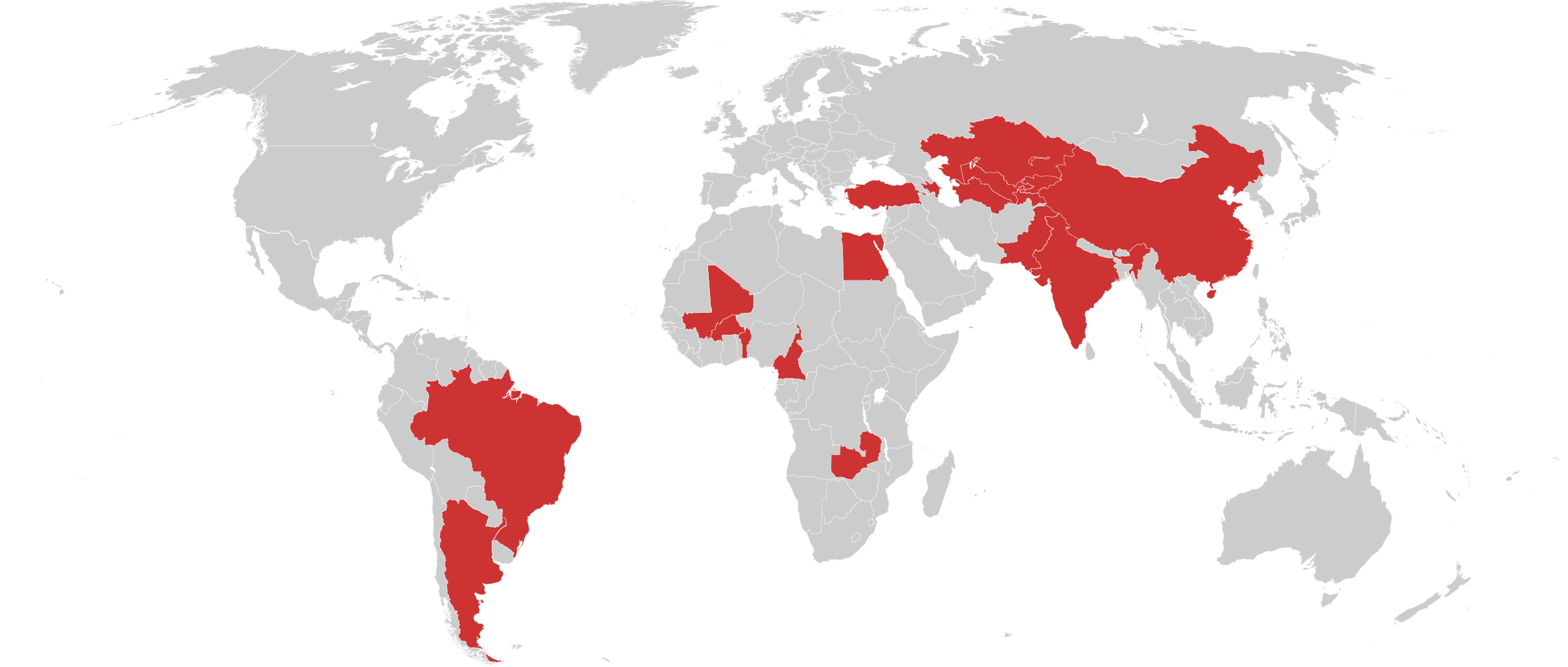
Cotton is reportedly produced with forced labor (FL) and/or child labor (CL) in the following countries:
- Argentina (CL)
- Azerbaijan (CL)
- Benin (CL, FL)
- Brazil (CL)
- Burkina Faso (CL, FL)
- Cameroon (CL)
- China (CL, FL)
- Egypt (CL)
- India – Cotton (CL)
- India – Cottonseed (hybrid) (CL, FL)
- Kazakhstan (CL, FL)
- Kyrgyz Republic (CL)
- Mali (CL)
- Pakistan (FL)
- Tajikistan (CL, FL)
- Turkey (CL)
- Turkmenistan (CL, FL)
- Uzbekistan (FL)
- Zambia (CL)
Top ten countries that produce cotton (lint and seed) worldwide (FAOSTAT 2018, 2019):
Cotton lint:
- India
- China
- United States
- Brazil
- Pakistan
- Turkey
- Australia
- Uzbekistan
- Mexico
- Greece
Cottonseed:
- China
- India
- United States
- Brazil
- Pakistan
- Uzbekistan
- Turkey
- Australia
- Mexico
- Argentina
Top ten countries that export cotton worldwide (International Trade Center 2019):[i]
- China
- United States
- India
- Pakistan
- Vietnam
- Brazil
- Turkey
- Uzbekistan
- Italy
- Hong Kong
[i] International Trade Center (ITC Calculations based on UNCOMTRADE Statistics). https://www.intracen.org/
Where is cotton reportedly produced with trafficking and/or child labor?
According to the U.S. Department of Labor List of Goods Produced by Child Labor or Forced Labor, cotton is produced with forced and child labor in Benin, Burkina Faso, China, India (cottonseed), Kazakhstan, Tajikistan, and Turkmenistan. Child labor is noted in Argentina, Azerbaijan, Brazil, Egypt, India (cotton), Kyrgyz Republic, Mali, Turkey, and Zambia. Forced labor is noted in Pakistan and Uzbekistan.[2]
Argentina is listed as Tier 1 country by the U.S. Department of State Trafficking in Persons Report. Benin, Brazil, Burkina Faso, Egypt, India, Tajikistan, and Turkey are listed as Tier 2 countries. Azerbaijan, Cameroon, Kazakhstan, Kyrgyz Republic, Mali, Pakistan, Uzbekistan, and Zambia are listed as Tier 2 Watch List countries. China and Turkmenistan are listed as Tier 3 countries.[3]
Cotton production and supply chain:
After harvesting by machine or hand, raw cotton is transported to gins where it is processed. Yarn is spun from lint. Cotton yarn is then woven into textiles, which are made into garments and home goods. Cottonseed is processed such that the meal is separated from the oil; the former is used in animal feed and the latter is used as cooking oil.
These production stages may occur across multiple countries, particularly for garments and textiles, making it difficult to determine where fibers in a given consumer item come from. For example, fibers from Egypt, Mali, and the United States may all be combined into one garment at a textile mill in Indonesia.
China and the United States are the largest exporters of cotton.[30] Both countries produce cotton products as well. China is a major importer of cotton, followed by Bangladesh, Vietnam, and Turkey.[31]
How do trafficking and/or child labor in
cotton production affect me?
Cotton produced using forced and/or child labor ends up in the clothes we wear, the textiles in our houses, and, through cottonseed oil, the food we eat.
Examples of what governments, corporations,
and others are doing:
There are numerous multi-stakeholder initiatives currently working to combat trafficking in cotton production worldwide. The Better Cotton Initiative (BCI), a multi-stakeholder group, aims to improve environmental practices of cotton production and improve livelihoods and working conditions by developing “Better Cotton” as a “sustainable mainstream commodity.” Better Cotton bales are segregated and traceable from farm to gin in a chain of custody system with guidelines and requirements at each step. During 2018-2019, 22% of global cotton production was in Better Cotton lint. Currently, farmers in more than 23 countries produce Better Cotton,[32] which is sourced by retailers and brands like Adidas, H&M, IKEA, Levi Strauss & Co., Marks and Spencer, and Nike.[33]
The Cotton Campaign is a multi-stakeholder group that includes NGO, government, investment, company and media partners advocating against trafficking in cotton production, particularly in Uzbekistan and Turkmenistan. The Campaign reports on forced labor in both countries, issues recommendations and facilitates dialogues among stakeholders. Most recently the Campaign developed and advocated for a model in Uzbekistan that “would allow producers not using forced labor to access international markets, while encouraging and facilitating responsible sourcing.”[34]
The Responsible Sourcing Network Cotton Programalso seeks to end forced labor in cotton sectors by working with a network of NGOs, apparel brands, retailers, investors, industry associations, and trade. The Cotton Program itself operates as a sustainable, responsible, and impact (SRI) investor. The Cotton Program hosts two “Cotton Pledge” campaigns for companies to sign on to, committing to not source their cotton from Uzbekistan or Turkmenistan.[35] The Cotton Program also hosts the initiative “YESS: Yarn Ethically and Sustainably Sourced” which implements a due diligence verification program with cotton yarn spinners.[36]
Clear Cotton project, a four-year project launched on March 1, 2018, aims to eliminate child labor and forced labor in cotton and focuses on three cotton-producing countries: Burkina Faso, Mali, and Pakistan as well as raising awareness in Peru.[37] The Clear Cotton project’s main objectives include: promoting “enhanced national legislation and policies,” and addressing “the basic needs and rights” of children working in the cotton value chain as well as victims of forced labor.[38] The project is co-funded by the European Union and implemented by the ILO in collaboration with the Food and Agriculture Organization.[39]
Fairtrade works with farmers across the globe and consults with a variety of stakeholders to address economic injustices, forced labor vulnerabilities, and environmental unsustainability. Fairtrade implements a unique pricing model to ensure farmers are paid a livable wage, sets rigorous standards at every step of the supply chain to ensure safe working conditions, and encourages eco-friendly cultivation without the use of dangerous pesticides. Fairtrade works to create demand for ethical goods in countries like the U.S., while supporting producers through local and regional expert networks.[40]
LEARN MORE
- Watch a video by the Environmental Justice Foundation.
- Read about the Better Cotton Initiative.
- Learn more about Fairtrade Cotton certification and sustainability efforts.
What do trafficking and/or child labor in
cotton production look like?
Government-sanctioned labor trafficking is a somewhat unique feature of cotton production, with much of the recent attention for this issue focusing on China. Hundreds of thousands of Uyghur Muslim and other Turkic ethnic minority laborers are forced to pick cotton in the Xinjiang region under coercive state-mandated labor schemes.[6] Under these labor schemes, Uyghurs and Kazakhs in Xinjiang, as well as Tibetans in the Tibet Autonomous Region, are transferred into labor camps by government officials under “precise poverty alleviation” policies that implement quota systems for the recruitment of poor households in cotton picking. Workers are isolated and surveilled closely by government, and sometimes police, forces. Religious minorities who have been placed in internment camps under the government’s ideological “re-education” of religious minorities can be recruited into these forced labor transfers. Secondary-school children are also reported to have been recruited in cotton harvesting in the Xinjiang region.[7]
Government-sanctioned coercion cotton production also continues to be documented in Uzbekistan. While the number of people forced to pick cotton decreased in 2019 by 40%,[8] the International Labor Rights Forum reported that the Uzbek government “remained closely involved in cotton production,” “used coercion to meet quotas and production targets” for cotton, and that government officials “required people to pick cotton involuntarily or face consequences including loss of job or problems at work.”[9] In Uzbekistan, cotton growing lands are divided and supervised by government authorities. Under the quota system, regional and local officials have been threatened with losing their jobs or other consequences if they fail to deliver quota amounts. Although the government production quota was eliminated in March 2020, local officials are still mandated to meet production targets.[10] Furthermore, as Uzbek cotton production is increasingly privatized, with companies controlling production in their cotton “cluster,” farmers enter contracts that closely resemble the quota system as they have to produce contract amounts, and lack bargaining power or choice over which clusters to work with.[11]
Trafficking in the cotton sector in Turkmenistan, Azerbaijan, and Tajikistan follows similar dynamics as those at play in Uzbekistan. The Turkmenistan government owns all the land in the country, which farmers lease, and enacts punitive measures like fines and land confiscation against farmers who fail to meet the state’s inflated production quotas.[12] Farmers are required to sell their produced cotton to the state at artificially low prices. Public sector workers are also required to harvest the cotton under threat of losing their jobs, and private sector businesses may also be required to provide labor or financial assistance to the annual harvesting effort.[13] Similarly, in Tajikistan, teachers and other government sector employees are recruited by the government to pick cotton under threat of losing their jobs. According to news media reports, farmers working on government leased land in Tajikistan face little choice in what they cultivate.[14] In Azerbaijan, restrictive rights to land ownership have resulted in the abuse of power from executive authorities who also coerce farmers into sowing cotton under the menace of land confiscation.[15]
Although has Uzbekistan banned child labor, Human Rights Watch reported in 2020 that following the outbreak of COVID-19, monitors of cotton harvests found more child labor, citing school closings as a likely cause.[16] The COVID-19 pandemic and school closures have also led to child labor in cotton production in Kazakhstan, though evidence suggests this occurred prior to the pandemic as well; the lack of access to technology for remote learning among rural households and interruptions to channels of migrant workers from Uzbekistan for cotton picking have resulted in children being recruited to work in cotton production.[17]
In Azerbaijan, children under the age of 15 were reported to have labored alongside their parents to supplement family incomes. Child labor was also prevalent in Turkey where Syrian refugee children and children of Turkish migrant families and tenant farmers labored in cotton harvesting. Child labor was especially reported in Şanlıurfa where there were lower levels of mechanization and an increased refugee population.[18] Although child labor is banned in Turkey, in the southeastern part of the country (a key cotton production region) it has been documented that some families struggling economically have their children work on cotton plantations to maximize income, since families are often paid based on total harvest.[19]
In much of the world, particularly in African countries like Zambia, Benin, Burkina Faso, and Mali, cotton is grown in a small-holder context. Children often work on their family’s plot. Some children may be involved in the worst forms of child labor if they are exposed to dangerous conditions including long hours, heat, and pesticides, and if they forego their education due to their cotton-related work. In other cases, children perform age-appropriate light tasks and continue to participate in schooling, which does not necessarily constitute a worst form of child labor.
Child migration in West African countries, such as Burkina Faso, Mali, and Benin, is also relatively common. Boys aged ten and above migrate from their rural homes to work on farms in other regions of the country, most often traveling to cotton-producing regions to assist in the cotton harvest. In some cases, these children migrate within well-established family or community “kinship” systems. This migration is not always voluntary as some children are pushed into conditions of forced labor. Some children working for farmers may not be paid until the end of the harvest cycle, if they are paid at all. Many times, payment is deferred even longer, and the end wages are often much less than promised.[20] Some migrant juvenile workers may be paid in goods rather than cash according to verbal agreements with the farmer. For example, a worker may request a new bicycle and clothes at the end of the harvest.[21] In other cases, migration may be under coercion or outright trafficking. In 2012, Interpol rescued over 400 child trafficking victims from Burkina Faso, some of whom were reportedly working on cotton farms.[22] According to media reports, in some instances children from Benin, Burkina Faso and Mali are reportedly sold to neighboring countries like Togo and Côte d’Ivoire to work on plantations.[23] School enrollment among children in these three origin countries is reportedly also low.
In Cameroon, children are recruited for forced labor on cotton plantations. Violent conflict in the Northwest and Southwest regions has increased internal displacement, lowered police and judicial enforcement, and worsened economic and educational opportunities. Parents from rural areas may entrust their children to traffickers after being promised the availability of better education opportunities in urban centers. Similar schemes to recruit child labor were reported in Benin.[24]
In India, forced child labor is reportedly used in some regions for the cross-pollination of cottonseed plots. According to NGOs, child labor was reported in cottonseed production across Rajasthan, Gujarat, Karnataka, Andhra Pradesh and Telangana, in order of highest to lowest incidence.[25] According to civil society organizations, children are forced to work across the cotton supply chain in India including in cotton fields, mills, factories, and home-based operations.[26] Children reportedly often remain invisible to labor inspections, and in 2019 about half of children involved in cottonseed production had dropped out of school. Furthermore, many cottonseed workers, especially women, were paid less than legal minimum wage.[27]
Children can be involved in all stages of the supply chain: cultivation, harvesting, ginning, and manufacturing. In cultivation and harvesting, child laborers are forced to work long hours; exhaustion, heat stroke, and malnutrition are common. Children are also exposed to harsh chemicals as cotton uses more insecticide than any other crop, making up 16 percent of global use. Exposure to these chemicals can cause tremors, nausea, weakness, blurred vision, extreme dizziness, headaches, depression, and even paralysis or death. In ginning, children work without protective equipment, inhaling contaminated air, which leads to respiratory problems.[28]
Endnotes
[2] U.S. Department of Labor. 2020 List of Goods Produced by Child Labor or Forced Labor. 2020. https://www.dol.gov/sites/dolgov/files/ILAB/child_labor_reports/tda2019/2020_TVPRA_List_Online_Final.pdf
[3] U.S. Department of State. Trafficking in Persons Report. 2020. https://www.state.gov/wp-content/uploads/2020/06/2020-TIP-Report-Complete-062420-FINAL.pdf
[4] European Commission. “Clearing cotton from child labour.” 2020. https://ec.europa.eu/international-partnerships/stories/clearing-cotton-child-labour_en
[5] International Labour Organization Child Labour in Cotton. 2016. https://www.ilo.org/ipecinfo/product/download.do?type=document&id=29655
[6] Zenz, Adrian. Center for Global Policy. Coercive Labor in Xinjiang: Labor Transfer and the Mobilization of Ethnic Minorities to Pick Cotton. December, 2020. https://media.business-humanrights.org/media/documents/20201214-PB-China-Zenz-11.pdf
[7] Zenz, Adrian. Center for Global Policy. Coercive Labor in Xinjiang: Labor Transfer and the Mobilization of Ethnic Minorities to Pick Cotton. December, 2020. https://media.business-humanrights.org/media/documents/20201214-PB-China-Zenz-11.pdf
[8] International Labour Organization. “Forced and child labour in Uzbek cotton fields continues to fall.” February 5, 2020. https://www.ilo.org/global/about-the-ilo/newsroom/news/WCMS_735883/lang–en/index.htm
[9] International Labor Rights Forum. Comments Concerning the Ranking of Uzbekistan by the United States Department of State in the 2020 Trafficking in Persons Report. 2020. https://laborrights.org/sites/default/files/publications/20200228_ILRF_Uzbekistan_%20TIP.pdf
[10] Cotton Campaign. A Changing Landscape in Uzbek Cotton Production. January 27, 2021. https://www.cottoncampaign.org/a-changing-landscape-in-uzbek-cotton-production.html
[11] International Labor Rights Forum. Comments Concerning the Ranking of Uzbekistan by the United States Department of State in the 2020 Trafficking in Persons Report. 2020. https://laborrights.org/sites/default/files/publications/20200228_ILRF_Uzbekistan_%20TIP.pdf
[12] International Labor Rights Forum. Comments Concerning the Ranking of Turkmenistan by the United States Department of State in the 2020 Trafficking in Persons Report. 2020. https://laborrights.org/sites/default/files/publications/20200228_ILRF_Turkmenistan_TIP.pdf.
[13] Cotton Campaign. Turkmenistan. 2017 Findings of Forced Labor Monitoring during Cotton Harvesting. 2018 https://www.cottoncampaign.org/reports-of-forced-labor-in-turkmenistans-cotton-sector.html.
[14] Eurasianet. “Teachers toil in cotton fields as Tajikistan tries to fix trade imbalance.” November 14, 2019. https://eurasianet.org/teachers-toil-in-cotton-fields-as-tajikistan-tries-to-fix-trade-imbalance.
[15] Taghiyeva, Tahmina. Meydan.TV. “The true price of Azerbaijani cotton.” August 14, 2018. https://www.meydan.tv/en/article/the-true-price-of-azerbaijani-cotton/?/ref=redirect.
[16] Human Rights Watch. “Central Asia: Pandemic Response Threatens Rights”. January 13, 2021. https://www.hrw.org/news/2021/01/13/central-asia-pandemic-response-threatens-rights.
[17] Kumenov, Almaz. Eurasianet. “Kazakhstan: Education-starved children sent to pick cotton.” October 15, 2020. https://eurasianet.org/kazakhstan-education-starved-children-sent-to-pick-cotton.
[18] Fair Labor Association. Child Labor In Cotton Supply Chains: Action-based Collaborative Project to Address Human Rights Issues in Turkey. 2017. https://www.fairlabor.org/sites/default/files/documents/reports/child_labor_in_cotton_supply_chains_june_2017.pdf
[19] Deutsche Welle. “Turkey: Children at work, not at school.” February 9, 2019. https://www.dw.com/en/turkey-children-at-work-not-at-school/av-47408727.
[20] de Lange, Albertine. “Going to Kompienga.” A Study of Child Labour Migration and Trafficking in Burkina Faso’s South-Eastern Cotton Sector. Amsterdam: International Research on Working Children (IREWOC). 2006. https://www.childtrafficking.com/Docs/lange_d_alb06gtkompienga_061106.pdf
[21] de Lange, Albertine. “Going to Kompienga.” A Study of Child Labour Migration and Trafficking in Burkina Faso’s South-Eastern Cotton Sector. Amsterdam: International Research on Working Children (IREWOC). 2006. https://www.childtrafficking.com/Docs/lange_d_alb06gtkompienga_061106.pdf
[22] Interpol. ”Nearly 400 victims of child trafficking rescued across Burkina Faso in INTERPOL-led operation”. November 22 2012. https://www.interpol.int/News-and-media/News/2012/PR096.
[23]Afrol News. “Labour Standards violated in Benin, Burkina Faso, Mali.” June 30, 2015. https://www.afrol.com/articles/13491.
[23] U.S. Department of State. 2020 Trafficking in Persons Report. 2020. https://www.state.gov/wp-content/uploads/2020/06/2020-TIP-Report-Complete-062420-FINAL.pdf.
[25] Arisa. Sowing Hope. 2020. https://arisa.nl/wp-content/uploads/SowingHope.pdf.
[26] Sekhon, Geeta. The Asia Foundation. “Forced Labor and Child Trafficking in India’s Garment Sector.” 2017. https://asiafoundation.org/2017/09/20/forced-labor-child-trafficking-indias-garment-sector/.
[27] Arisa. Sowing Hope. 2020. https://arisa.nl/wp-content/uploads/SowingHope.pdf.
[28] World Vision. Forced and Child Labour in the Cotton Industry. March 2012. https://campaign.worldvision.com.au/wp-content/uploads/2013/04/Forced-and-child-labour-in-the-cotton-industry-fact-sheet.pdf
[29] Food and Agriculture Organization of the UN, Statistics Division (FAOSTAT). FAOSTAT Database: Food and Agricultural Commodities Production /Countries by Commodity. 2012. https://faostat3.fao.org/faostat-gateway/go/to/browse/rankings/countries_by_commodity/E
UN Department of Economic and Social Affairs. UN Comtrade Database. 2012. https://comtrade.un.org/data/
[30] International Trade Center (ITC Calculations based on UNCOMTRADE Statistics). https://www.intracen.org/
[31] World Vision. Forced and Child Labour in the Cotton Industry. March 2012. https://campaign.worldvision.com.au/wp-content/uploads/2013/04/Forced-and-child-labour-in-the-cotton-industry-fact-sheet.pdf
[32] Better Cotton Initiative. “Where is Better Cotton Grown?” 2019. https://bettercotton.org/where-is-better-cotton-grown/.
[33] United Nations Global Compact. Better Cotton Initiative. https://supply-chain.unglobalcompact.org/site/article/26
[34]Cotton Campaign. “A Changing Landscape in Uzbek Cotton Production.” January 27, 2021. https://www.cottoncampaign.org/a-changing-landscape-in-uzbek-cotton-production.html.
[35] Responsible Sourcing Network. “Cotton.” 2021. https://www.sourcingnetwork.org/cotton.
[36] Responsible Sourcing Network. “YESS.” 2021. https://www.sourcingnetwork.org/yess.
[37] International Labour Organization. Eliminating child labour and forced labour in the cotton, textile and garment value chains: an integrated approach. https://www.ilo.org/islamabad/whatwedo/projects/WCMS_648369/lang–en/index.htm
[38] Clear Cotton. ILO. https://www.ilo.org/wcmsp5/groups/public/—ed_norm/—ipec/documents/publication/wcms_650172.pdf
[39] Europa. Clear Cotton project seeks halt to child labour in West Africa and Pakistan. https://europa.eu/capacity4dev/platform-rmsc-garment-sector/discussions/clear-cotton-project-seeks-halt-child-labour-west-africa-and-pakistan
[40] Fairtrade America. “Fairtrade Certified Clothing and Textiles.” 2021. https://www.fairtradeamerica.org/shop-fairtrade/fairtrade-products/clothing-textiles/.