
Trafficking Risk in Sub-Saharan African Supply Chains
Home / Explore by Commodity / Explore by Country / Understand Risk / Additional Resources / About the Project
Coffee
Summary of Key Trafficking in Persons Risk Factors in Coffee Production
Long, Complex, and/or Non-transparent Supply Chains
Seasonal Surges in Labor Demand
✓ Undesirable and Hazardous Work
✓ Vulnerable Workforce
Child Labor
Migrant Labor
Casual Labor
Gendered Dynamics of Production
✓ Presence of Labor Intermediaries
Overview of Coffee Production in Sub-Saharan Africa
TRADE
The top exporters of coffee from sub-Saharan Africa are Ethiopia, Uganda, Kenya, Tanzania, and Côte d’Ivoire.[1]
[2]
The value of coffee exports from Africa is trending upward, despite dropping from a peak in 2012.[5]
[6]
Other countries, including Madagascar, Cameroon, the Democratic Republic of the Congo, Guinea, Rwanda, and Côte d’Ivoire also have significant coffee production.[8]
Ethiopia, Uganda, Madagascar, and Sierra Leone had the biggest growth in coffee production between 2005 and 2015.[9]
The top importing countries of coffee from sub-Saharan African countries are Germany, the United States, Italy, Belgium, and Saudi Arabia.[10]
There are no or low tariffs for African exports of unprocessed (“green”) and roasted coffee to the EU and United States. Processed coffee tariffs for the EU and the United States are around 10 percent.[11]
In general, African coffee value chains have been characterized by relatively low yields and supply chain inefficiencies.[12] Brazil, the leading producer of coffee globally, has nearly double the yield of Ethiopia. Part of the discrepancy in productivity is explained by the fact that the majority of African countries rely on small-holder production, whereas South American and Asian producing countries are more likely to use larger plantations or estates.[13]
FEATURES OF PRODUCTION AND SUPPLY CHAIN
The majority of coffee globally, and in Africa specifically, is grown by smallholder farms.[14] Over 98 percent of coffee in Uganda is grown on smallholder farms.[15] Smallholder farms often intercrop coffee with other crops such as grains, fruits, or vegetables. In Ethiopia, coffee supports an estimated 1.5 million people and the vast majority is grown on smallholder farms, with only about five percent being grown on larger plantations.[16] Small-holders produce about 90 percent of the coffee in Tanzania.[17] Coffee can also be grown in shade or semi-shade environments.
Labor in coffee production on smallholder farms is performed by farmers and their family members as well as hired workers. Larger plantations employ many workers. Gendered divisions of tasks can vary, but weeding is often predominantly performed by women while men are more heavily involved in pruning and land preparation. Both men and women harvest beans.
Africa produces both Arabica and Robusta varieties of coffee. Robusta is typically lower-quality and therefore lower value.[18] It is more likely to be grown in full-sun.[19] Robusta is primarily produced in Kenya, Tanzania, Rwanda, Cameroon, Côte d’Ivoire, Burundi, and Madagascar.[20] Arabica is higher quality and tends to be grown at higher altitudes, in shaded environments.[21] The primary producers of Arabica are Ethiopia, Tanzania, and Kenya.[22] The presence of Arabica beans increases the total value of these countries’ coffee exports.
Coffee production requires the most labor during the harvest season, when an influx of workers is needed to harvest the beans in a timely way. When beans are ripe, they must be harvested and processed quickly to maintain quality. In many cases, this leads to the use of short-term, casual workers, on both plantations and smaller farms.[23] In the rush to harvest ripe beans, workers may be required to work extremely long hours. Coffee plants bear fruit approximately three to four years after planting, and the fruit turns red when it is ready to be harvested. Harvesting coffee cherries is labor intensive. Cherries are either “strip picked” or “selectively picked.” If cherries are strip picked, all are harvested at one time. When cherries are selectively picked, only the ripe ones are picked. Picking selectively is more labor intensive and often reserved for higher quality beans. There are one or two major harvests per year and pickers average approximately 100-200 pounds of cherries a day. Workers are normally paid by the weight of cherries picked.[24]
After harvest, the resulting beans are milled. There may be one or more layers of middlemen who aid in consolidation and transport of coffee from farms to mills. Mills generally sell to international traders who sell to roasting companies. Retailers purchase from roasting companies, sometimes via wholesalers or other intermediaries.[25]
The above process, however, describes a highly simplified version of the supply chain. In reality, coffee may change hands over 100 times,[26] leading to an opaque supply chain, with a lack of visibility to the beans’ origins. Coffee from different sources can be mixed at several different points in the supply chain, including mills, traders or other intermediaries.[27]
Example of Coffee Supply Chain Model
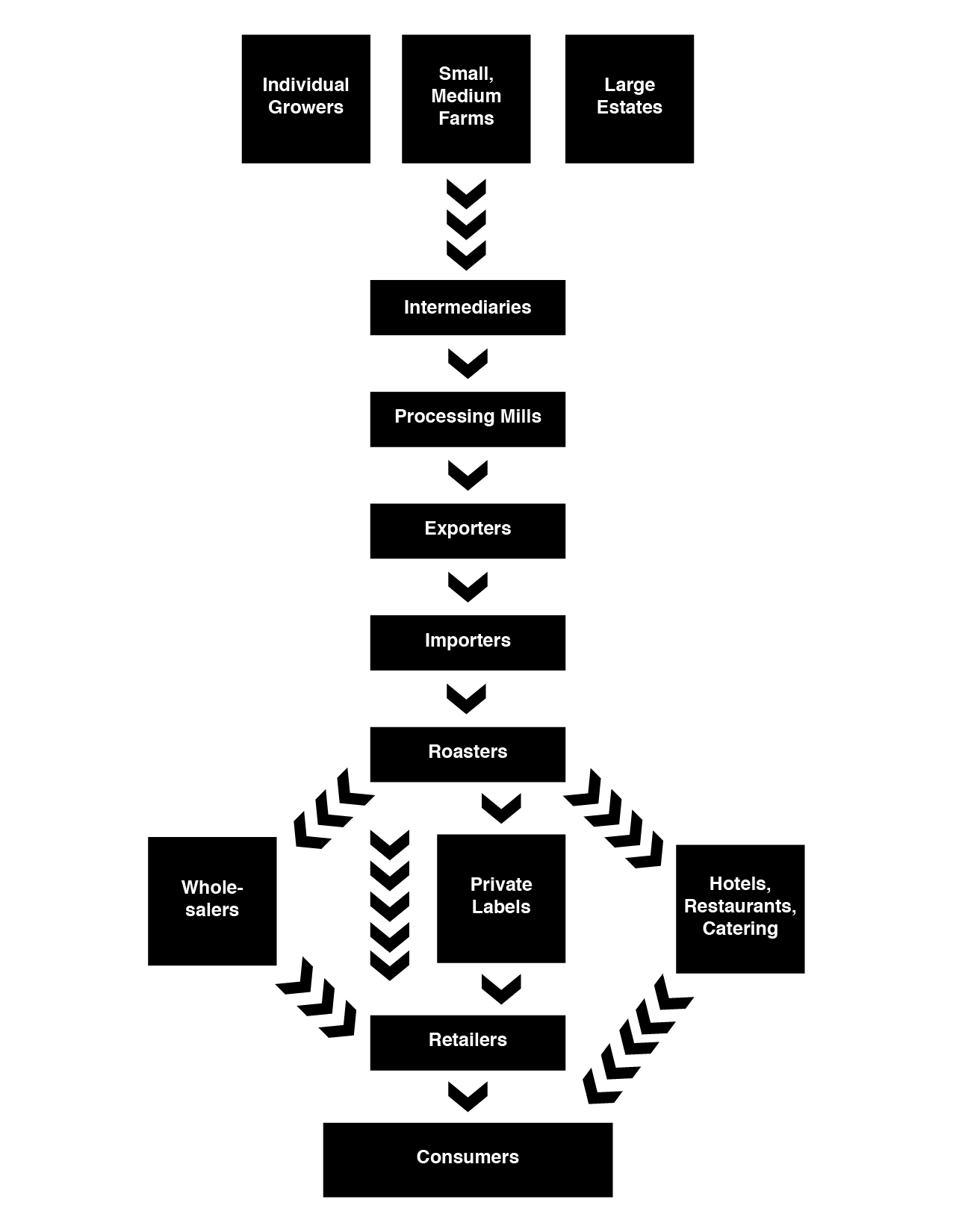
[28]
Specialty coffee may be imported at a higher negotiated price, but farmers may not benefit from this premium, as it more likely accrues to the trader. Volatile coffee prices[30] can put strong pressure on coffee farmers and plantations to decrease all input costs, including labor, which is often the only input over which they have control. Labor reportedly accounts for up to 70 percent of production costs.[31] When prices are particularly low, farmers sell their beans for less than the cost of production, leaving many coffee producing families far below the poverty line.[32]
Key Documented Trafficking in Persons Risk Factors in Coffee Production
According to the 2019 U.S. Department of State’s Trafficking in Persons Report, coffee is produced with forced child labor in Côte d’Ivoire and Togo.[34] The U.S. Department of Labor’s 2018 List of Goods Made with Forced Labor and Child Labor indicates that coffee is produced with forced labor in Côte d’Ivoire.[35]
UNDESIRABLE AND HAZARDOUS WORK
Coffee production is highly labor-intensive, particularly in Africa, where nearly all work is performed manually. Tasks include land preparation, weeding, pruning trees, spraying fertilizers or pesticides, hand-harvesting, and transporting. The International Labor Organization (ILO) has identified several specific health risks involved in coffee production and harvesting, including injuries from sharp tools, injuries from repetitive movements, lifting heavy loads, pesticide exposure or poisoning, respiratory illness from exposure to coffee dust, and sun and heat exposure.[36]
VULNERABLE WORKFORCE
Child Labor
The U.S. Department of Labor’s 2018 List of Goods Made with Forced Labor and Child Labor indicates that coffee is produced with child labor in Côte d’Ivoire, Guinea, Kenya, Sierra Leone, Tanzania, and Uganda.[37]
Smallholder coffee farms rely heavily on family labor, and children are likely to work on family farms. On larger plantations, children may work alongside their parents either to supplement their families’ income, to help parents meet their production quotas, or because the children of migrant parents have nowhere else to go during the day if they are not enrolled in school.[38] Children involved in coffee production take on a variety of tasks including picking and sorting berries, pruning trees, weeding, fertilizing, and transporting beans and other supplies. Children are even more vulnerable to the risks faced by adult workers in coffee production, particularly carrying heavy loads, exposure to pesticides and dust, and injuries from sharp objects.
Oxfam estimates that one-third of coffee harvesters in Kenya are under 15 years old.[39] An ILO report notes that where child labor exists in the Kenyan coffee sector, it is actually more likely to be present on commercial plantations than on smallholder farms. The risk is particularly high on commercial estates that use piece-rate or quota requirements for adult workers, which can incentivize those workers to involve their children to meet the quotas.[40]
In Tanzania, children work on family farms, neighboring small farms, and estates.[41] One study found that the average age at which children begin working in coffee in Uganda is eleven, and that 48 percent of children working in the sector reported physical injuries.[42]
[43]
Information on the demographics of hired workers is lacking, but the presence of migrant workers has been noted in several countries. A 2014 study on workers in Uganda and Ethiopia noted the presence of seasonal migrants, but did not specify their origins.[44] However, the research did note that seasonal migrants tended to be workers who lacked access to their own land; some were from land-scarce, poor rural regions while others were women who could not secure their own property.[45]
There is little information on migrant workers in the coffee sector specifically of Côte d’Ivoire, but coffee is often grown by the same farmers that grow cocoa, where migrant labor, including migrant child labor has been documented.[46] These anecdotal findings are supported by the fact that both cocoa and coffee are grown in the same forested region of the country.[47]
Casual hired workers in coffee supply chains globally are receiving heightened attention in recent years as a highly vulnerable and often “invisible” population.[49]
Both estates and small-holder farmers hire casual workers.[50] An ILO study of coffee plantations in Kenya found that over 20 percent of hired labor on estates was casual or part-time, as a function both of unpredictable harvest needs, as well as a means to avoid labor laws that require benefits for full-time workers.[51] Casual hired labor was also noted as widespread in a 2014 study of coffee production in Ethiopia and Uganda.[52]
Gendered Dynamics of Production
Women in coffee production are concentrated in lower skilled tasks, but work more hours overall. Women are more likely to be involved in field work, harvesting and processing. Men are more likely to be involved in transporting and marketing the beans.[53] A 2002 report from the International Labor Rights Forum cited widespread abuse and harassment of female plantation workers in Kenya, including rape and physical assault by supervisors.[54]
In Côte d’Ivoire, there are anecdotal reports that the intermediaries who facilitate migration and hiring in the cocoa sector are also active in the coffee sector.[55] In the cocoa sector, research has found that migrants arriving from neighboring countries including Mali and Burkina Faso may become indebted to intermediaries who pay their travel expenses. In some cases, these migrant workers may work for multiple seasons without pay in highly isolated forest camps and report that they did not understood the terms of employment when they were recruited.[56]
Related Resources
Compliance Resources for Companies
Information and Good Practices at the Industry Level
Explore Risk in Global Commodity Supply Chains
Endnotes
[1] International Trade Centre. Trade Map. www.trademap.org.
[2] International Trade Centre. Trade Map. www.trademap.org.
[3] African Development Bank. Coffee Production in Africa and the Global Market Situation. 2010. https://www.afdb.org/fileadmin/uploads/afdb/Documents/Publications/4-Coffee%20Production%20in%20Africa.pdf
[4] International Trade Centre. Trade Map. www.trademap.org.
[5] International Trade Centre. Trade Map. www.trademap.org.
[6] International Trade Centre. Trade Map. www.trademap.org.
[7] Global Coffee Platform. African Coffee Sector Investment Opportunities. September 2016. https://www.globalcoffeeplatform.org/assets/files/Documents/African-Coffee-Investment-Agendas/African-Coffee-Investment-Agendas-Summary-Report.pdf.
[8] United Nations Food and Agriculture Organization. FAO STAT. Production. 2014. https://www.fao.org/faostat/en/#data/QC.
[9] Global Coffee Platform. African Coffee Sector Investment Opportunities. September 2016. https://www.globalcoffeeplatform.org/assets/files/Documents/African-Coffee-Investment-Agendas/African-Coffee-Investment-Agendas-Summary-Report.pdf.
[10] International Trade Centre. Trade Map. www.trademap.org.
[11] International Trade Center. The markets for coffee- Tariff barriers. https://www.intracen.org/coffee-guide/the-markets-for-coffee/Tariff-barriers/.
[12] Global Coffee Platform. African Coffee Sector Investment Opportunities. September 2016. https://www.globalcoffeeplatform.org/assets/files/Documents/African-Coffee-Investment-Agendas/African-Coffee-Investment-Agendas-Summary-Report.pdf.
[13] United Nations Food and Agriculture Organization. FAO STAT. Crops. 2014. https://www.fao.org/faostat/en/#data/QC.
[14] Oxfam. Grounds for Change. April 2006. https://www.oxfam.org/sites/www.oxfam.org/files/coffee.pdf.
[15] The Sustainable Trade Initiative (IDH). A Business Case For Sustainable Coffee Production. December 2013. https://www.sustainablecoffeeprogram.com/site/getfile.php?id=212.
[16] USAID. Ethiopia Coffee Industry Value Chain Analysis. June 18, 2010. https://agoa.info/toolkit/downloads/5157.html.
[17] Senelwa, Kennedy. “Coffee production in East Africa set to fall.” The East African. June 25, 2016. https://www.theeastafrican.co.ke/business/Coffee-production-in-East-Africa-set-to-fall–/2560-3267428-cjw2c6/index.html.
[18] United Nations Food and Agriculture Organization (UNFAO). FAO Statistical Pocketbook. Coffee 2015. https://www.fao.org/3/a-i4985e.pdf
Coffee and Conservation. All About Robusta. 2011. https://www.coffeehabitat.com/2011/07/all-about-robusta-what-it-is-and-what-it-might-be/
[19] United Nations Food and Agriculture Organization (UNFAO). FAO Statistical Pocketbook. Coffee 2015. https://www.fao.org/3/a-i4985e.pdf
Coffee and Conservation. All About Robusta. 2011. https://www.coffeehabitat.com/2011/07/all-about-robusta-what-it-is-and-what-it-might-be/
[20] United Nations Food and Agriculture Organization (UNFAO). Africa Coffee Producing Country Profiles. https://www.fao.org/docrep/003/x6939e/X6939e10.htm
Coffee and Conservation. Coffee in Africa. 2006. https://www.coffeehabitat.com/2006/04/coffee_growing__1-2/
[21] Coffee and Conservation. All About Robusta. 2011. https://www.coffeehabitat.com/2011/07/all-about-robusta-what-it-is-and-what-it-might-be/
National Coffee Association USA. Coffee Around the World. https://www.ncausa.org/About-Coffee/Coffee-Around-the-World
[22] United Nations Food and Agriculture Organization (UNFAO). Africa Coffee Producing Country Profiles. https://www.fao.org/docrep/003/x6939e/X6939e10.htm.
Coffee and Conservation. Coffee in Africa. 2006. https://www.coffeehabitat.com/2006/04/coffee_growing__1-2/
[23] International Labor Organization (ILO). Safety and Health Fact Sheet: Hazardous Child Labour in Agriculture: Coffee. 2004. www.ilo.org/ipecinfo/product/download.do?type=document&id=5708.
[24] National Coffee Association. 10 Steps to Coffee from Seed to Cup. https://www.ncausa.org/i4a/pages/index.cfm?pageid=69.
[25] Finnwatch. Brewing up a sustainable coffee supply chain: The social responsibility of coffee roasters and private label coffee in Finland. 2016. https://www.finnwatch.org/images/pdf/FW_Coffee_report_18102016.pdf
[26] SOMO. A fair share for smallholders: A value chain analysis of the coffee sector. 2006. https://www.fao.org/3/a-at226e.pdf.
[27] Finnwatch. Brewing up a sustainable coffee supply chain: The social responsibility of coffee roasters and private label coffee in Finland. 2016. https://www.finnwatch.org/images/pdf/FW_Coffee_report_18102016.pdf.
[28] Adapted from Finnwatch. Brewing up a sustainable coffee supply chain: The social responsibility of coffee roasters and private label coffee in Finland. 2016. https://www.finnwatch.org/images/pdf/FW_Coffee_report_18102016.pdf.
[29] Mungai, Christine. World Economic Forum. Which African countries produce the most coffee. October 22, 2015. https://www.weforum.org/agenda/2015/10/which-african-countries-produce-the-most-coffee/.
[30] Oxfam. Grounds for Change. April 2006. https://www.oxfam.org/sites/www.oxfam.org/files/coffee.pdf.
[31] Fair Trade USA. Child Labor in Coffee Supply Chains. January 27, 2017. https://fairtradeusa.org/press-room/press_release/child-labor-coffee-supply-chains.
[32] International Labor Organization (ILO). Safety and Health Fact Sheet: Hazardous Child Labour in Agriculture: Coffee. 2004. www.ilo.org/ipecinfo/product/download.do?type=document&id=5708.
[33] United Nations Development Programme (UNDP). Human Development Index. 2018. https://hdr.undp.org/en/content/human-development-index-hdi.
[34] U.S. Department of State. Trafficking in Persons Report. 2019.https://www.state.gov/reports/2019-trafficking-in-persons-report/ .
[35] U.S. Department of Labor. 2018 List of Goods Produced by Child Labor or Forced Labor. 2018. https://www.dol.gov/sites/dolgov/files/ILAB/ListofGoods.pdf.
[36] International Labor Organization (ILO). Safety and Health Fact Sheet: Hazardous Child Labour in Agriculture: Coffee. 2004. www.ilo.org/ipecinfo/product/download.do?type=document&id=5708.
[37] U.S. Department of Labor. 2018 List of Goods Produced by Child Labor or Forced Labor. 2018. https://www.dol.gov/sites/dolgov/files/ILAB/ListofGoods.pdf.
[38] Global Exchange. Coffee FAQ. https://www.globalexchange.org/fairtrade/coffee/faq#1.
Fair Trade USA. Child Labor in Coffee Supply Chains. January 27, 2017. https://fairtradeusa.org/press-room/press_release/child-labor-coffee-supply-chains https://fairtradeusa.org/press-room/press_release/child-labor-coffee-supply-chains.
[39] Oxfam. The Coffee Market: A Background Study. 2001. https://www.oxfamamerica.org/static/media/files/mugged-full-report.pdf.
[40] Mueithi, Leopold. International Labour Organization. Coffee in Kenya: Some challenges for decent work. 2008. https://pdfs.semanticscholar.org/ba34/dc1f9d644d2d627a3f7647f0cf227014c9e4.pdf.
[41] U.S. Department of Labor. Situation Analysis on Child Labor in Tanzania Mainland and Zanzibar. 2011. https://www.dol.gov/ilab/reports/pdf/TanzaniaSA2011.pdf.
[42] Obua, P. BVSDE. Child Labour in commercial agriculture in Uganda. 2004. https://www.bvsde.paho.org/bvsacd/cd46/child.pdf.
[43] Karega, Regina G.M. International Labor Rights Fund (ILRF). Violence Against Women in the Workplace in Kenya. May 2002. https://www.laborrights.org/sites/default/files/publications-and-resources/Kenya.pdf.
[44] FTEPR. Fairtrade, Employment and Poverty Reduction in Ethiopia and Uganda. April 2014. https://ftepr.org/wp-content/uploads/FTEPR-Final-Report-19-May-2014-FINAL.pdf.
[45] FTEPR. Fairtrade, Employment and Poverty Reduction in Ethiopia and Uganda. April 2014. https://ftepr.org/wp-content/uploads/FTEPR-Final-Report-19-May-2014-FINAL.pdf.
[46] Anti-Slavery International. The Cocoa Industry in West Africa: a history of exploitation.2004. https://www.antislavery.org/wp-content/uploads/2017/01/1_cocoa_report_2004.pdf.
[47] Ruf, Francois. Springer. Diversification of Cocoa Farms in Côte d’Ivoire: Complementarity of and Competition from Rubber Rent. July 16, 2015. https://www.springer.com/cda/content/document/cda_downloaddocument/9789401772938-c2.pdf?SGWID=0-0-45-1517485-p177566847.
[48] United Nations. International migrant stock: Total. https://www.un.org/en/development/desa/population/migration/data/estimates2/estimatestotal.shtml.
[49] Gress, Charis and Sophia Tickell. Oxfam. Mugged: Poverty in your coffee cup. 2002. https://www.oxfamamerica.org/static/media/files/mugged-full-report.pdf.
Sheridan, Michael. “Farmworkers in the Coffeelands.” Roast Magazine. January 2016. https://coffeelands.crs.org/wp-content/uploads/2016/01/Roast-Magazine-Farmworkers-in-the-Coffeelands.pdf.
[50] IDH and True Price. The True Price of Tea from Kenya. 2016. https://trueprice.org/wp-content/uploads/2016/04/TP-Tea.pdf.
[51] Mueithi, Leopold. International Labour Organization. Coffee in Kenya: Some challenges for decent work. 2008. https://pdfs.semanticscholar.org/ba34/dc1f9d644d2d627a3f7647f0cf227014c9e4.pdf.
[52] FTEPR. Fairtrade, Employment and Poverty Reduction in Ethiopia and Uganda. April 2014. https://ftepr.org/wp-content/uploads/FTEPR-Final-Report-19-May-2014-FINAL.pdf.
[53] Specialty Coffee Association of America. A Blueprint for Gender Equality in the Coffee Lands. https://www.scaa.org/PDF/scaa-white-paper-gender-equality.pdf.
[54] International Labor Rights Forum (ILRF). Violence Against Women in the Workplace in Kenya: Assessment of Workplace Sexual Harassment in the Commercial Agriculture and Textile Manufacturing Sectors in Kenya. May 2002. https://www.laborrights.org/sites/default/files/publications-and-resources/Kenya.pdf.
[55] Anti-Slavery International. The Cocoa Industry in West Africa: a history of exploitation. 2004. https://www.antislavery.org/wp-content/uploads/2017/01/1_cocoa_report_2004.pdf
[56] Robson, Paul. Anti-Slavery International. Ending Child Trafficking in West Africa: Lessons from the Ivorian cocoa sector. December 2010. https://www.antislavery.org/wp-content/uploads/2017/01/cocoa_report_small.pdf.
Trafficking Risk in Sub-Saharan African Supply Chains
Home / Explore by Commodity / Explore by Country / Understand Risk / Additional Resources / About the Project